


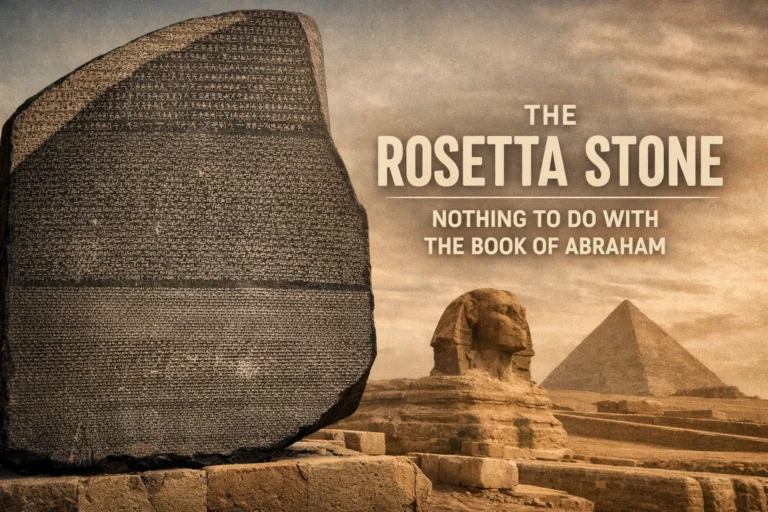
The Rosetta Stone chapter in A Letter For My Wife feels an impressive piece of evidence. Showing a real artifact that was instrumental in understanding Egyptian. It’s something most people recognize, so it provides some assumed authority. Faulk uses it to imply that modern Egyptology settled the Book of Abraham question long ago because of the Rosetta stone.
That implication collapses once you slow down and look at what the Rosetta Stone actually did.
The short version is this:
The Rosetta Stone helped solve a language problem.
The Book of Abraham raises a revelation problem.
Those are not the same thing.
The Rosetta Stone Never Translated Complex Egyptian
The Rosetta Stone does not do the work critics claim it does.
Champollion’s 1822 breakthrough identified that Egyptian symbols could function phonetically. That was not the same thing as having a usable grammar, dictionary, or translation system. Those tools did not exist in Joseph Smith’s lifetime.
By the 1830s, scholars could recognize basic names, titles, and some repeated formulaic expressions. The ability to translate extended Egyptian texts depended on grammatical and lexical frameworks that had not yet been developed.
The Rosetta Stone Reads Words, Not Pictures
The Rosetta Stone helped scholars match Egyptian symbols to sounds by comparing the same decree written in three scripts. That allowed Egyptologists to begin reading names, titles, and eventually sentences.
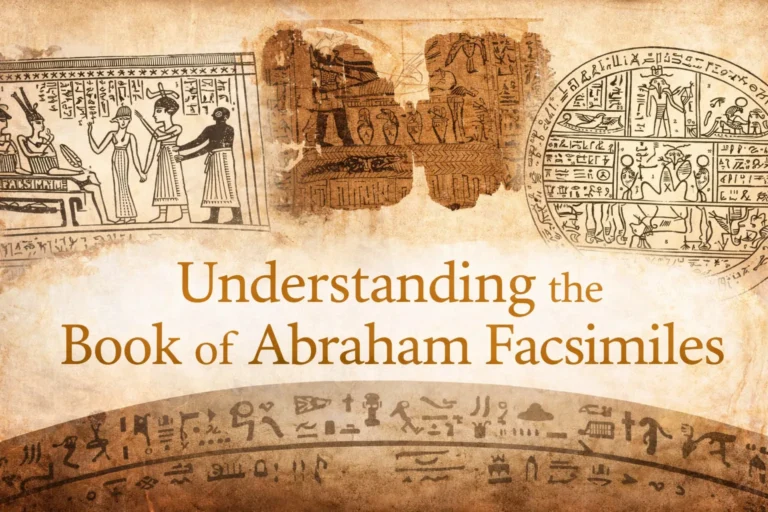
Facsimiles are not sentences. They are images.
Images like Facsimile 1 were meant to communicate meaning symbolically. Ancient Egyptian religious art worked through posture, placement, objects, repetition, and association with myth. That meaning does not come from sounding out words. It comes from interpreting symbols.
So even if Joseph Smith had been standing next to Champollion with a full dictionary, that would not turn Facsimile 1 into a paragraph you could translate word-for-word. That’s not how religious imagery functioned then, and it’s not how it functions now.
This alone makes the Rosetta Stone an irrelevant tool to bring into the discussion. It also shows a basic misunderstanding of how ancient images worked.
Joseph Smith Was Never Doing a Secular Translation
The Rosetta Stone argument only works if you assume Joseph Smith claimed to be doing a modern academic translation. He never did.
Joseph was explicit about how scripture came forth. He said it came “by the gift and power of God.” In the Book of Mormon, he translated without even looking at the plates, receiving the text through revelation using seer stones.
Ironically, Faulk himself spends an entire chapter emphasizing this point. He repeatedly argues that Joseph did not translate the Book of Mormon by reading ancient characters at all.
So this raises an obvious problem:
If Joseph translated the Book of Mormon by revelation, why would the Book of Abraham suddenly require a Champollion-style linguistic method?
Judging Joseph Smith as if he claimed to be doing a university-level language translation holds him to a standard he never claimed to meet. You don’t disprove revelation by showing it doesn’t behave like a language course.
We Don’t Have the Source Text Anyway
There is a more basic problem that makes the Rosetta Stone irrelevant from the start.
We do not have the source text.
Joseph Smith did not have a single scrap of papyrus. He had two full scrolls and several fragments. What survives today is only a small portion of those materials. The scrolls themselves were destroyed in the Chicago fire.
That means we do not have the text Joseph said the Book of Abraham came from.
Facsimile 1 is not the text. It never was. Joseph never claimed it was. The facsimiles are illustrations. The text Joseph referred to was on the scrolls, not in the picture captions.
There is no way to do a word-for-word comparison between the Book of Abraham and its original source because the source no longer exists. That alone should end any claim that the Rosetta Stone somehow “checked” Joseph Smith’s work.
The Kirtland Egyptian Papers Were Not a Rosetta Stone Attempt
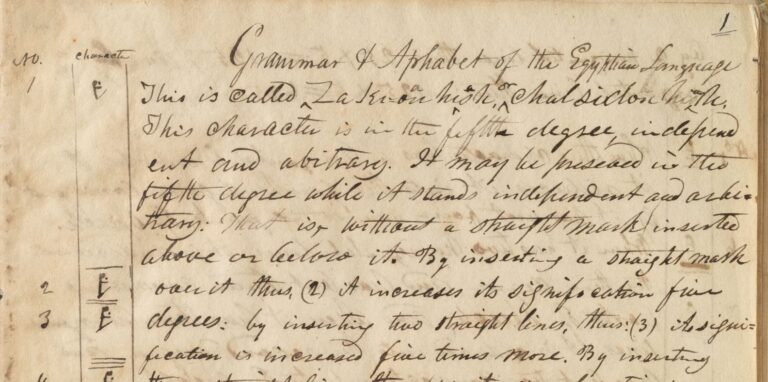
Faulk briefly gestures at the Kirtland Egyptian Papers as if they show Joseph trying to build his own Rosetta Stone. That reading does not fit the documents.
Those papers are not a translation project. They do not map to Egyptian grammar. They do not function like a dictionary. They attempt to organize revealed concepts as a coding system using degrees and layered symbols.
Most of this work was likely done by other church members, not Joseph himself, as they tried to systematize material connected to revealed doctrine from the Book of Abraham and the Doctrine and Covenants.
There is no evidence Joseph believed he was cracking Egyptian linguistics. Treating these papers as a failed decipherment project imports an assumption that simply does not belong there. No Egyptologist would mistake these papers for a linguistic translation attempt.
So Why Is the Rosetta Stone Even a Chapter?
The Rosetta Stone does not translate images.
It does not compare Joseph’s text to missing scrolls.
It does not match Joseph Smith’s translation claims.
It does not address symbolic religious art.
Its presence functions rhetorically, not analytically. It signals that “experts solved this” without explaining what was solved or whether it applies.
A Letter For My Wife uses the Rosetta Stone as a shortcut. It sounds conclusive, it makes it look like Faulk knows his history and did some research, but it is irrelevant to the spiritual translation of the Book of Abraham papyrus scrolls that we do not even have.
Final Thoughts
Joseph Smith never claimed to translate Egyptian the way modern scholars do. The Rosetta Stone does not translate religious images. We do not have the original Book of Abraham scrolls. And the facsimiles were never presented as the source text anyway.
Once those facts are on the table, the Rosetta Stone chapter doesn’t challenge the Book of Abraham at all. It only shows how often critics mistake familiarity for relevance.
The Rosetta Stone – The Ancient Relic Not Related to The Book of Abraham

Book of Abraham Facsimile 1
Understanding What The Book of Abraham Facimilies Are
Book of Abraham – Evidence Joseph Smith Could Not Have Known
The GAEL Project – Pre-Temple Doctrine Coding?
Doctrine of the Book of Abraham
What is the Book of Abraham?
Continue reading at the original source →