


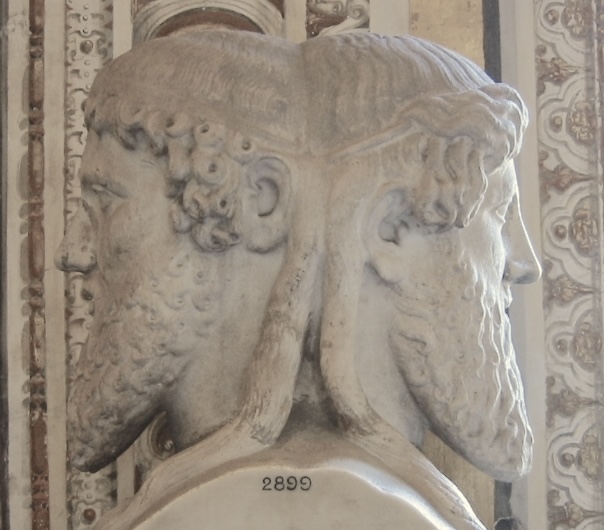
 I know T.S. Eliot famously claimed that “April is the cruelest month,” but I think January could challenge April for the title.
Like its Roman namesake, Janus, January is definitely two-faced. It’s a time of endings and beginnings, of looking forward and looking back. It combines the promise of a new year with the distinct after-Christmas boredom and return to routine. And in January, it always feels like winter will never end.
I always find January a hard month to get through.
This year, in particular, I’m having a hard time confronting January. A big part of is because my birthday is next week. I’m going to be 35. I have to confront the fact that I’m not exactly “young” anymore. (I’m technically old enough to be the mother to my freshmen students).
And, in the Janus fashion of looking forward and backward, I find myself looking at a life (past and future) that is, in so many respects, very ordinary. Don’t get me wrong, I love my life. (Most of the time). It’s just—this isn’t the life I envisioned a lifetime ago, when I was seventeen. Then, I was sure I was going to do something profound.
I was going to be special.
But here’s the thing: I think my realization of my ordinariness is actually a good thing, hard as it may be to relinquish childhood dreams of greatness.
A couple of months ago, a wise woman in my ward observed that when we say we want to feel special, most of the time we really mean that we want to be better than other people. Her observation was a minor epiphany for me. I saw, in my own desire to be special, roots of insecurity and envy. According to Merriam Webster, to be special is to be:
1. distinguished by some unusual quality; especially : being in some way superior
2. held in particular esteem
3. readily distinguishable from others of the same category : unique
Accepting that I am, in fact, not special in this sense helps me see the world around me as God might see it, as a collection of individuals who all have individual—and equal—worth. I’m slowly learning to disentangle my own sense of value from a sense of superiority.
At this point, I think some of you would argue that we *are* special (cue Max Lucado’s famous story here). But I don’t think we’re special in the way the world understands it, because of some innate uniqueness or superiority. We are special because we are “designed for a particular purpose or occasion” (Merriam Webster’s final definition of “special”).
And we’re back at the two-faced Janus again. It’s possible to be special and ordinary—after all, what makes something ordinary is it’s very ubiquity. There’s nothing particularly unique or rare about being a child of God, but that identity invests all of us with infinite worth.
There’s a children’s story that I absolutely adore, M.M Kaye’s The Ordinary Princess. In it, a crotchety old fairy shows up at the christening of the seventh princess. She takes one look at all the fancy fairy wishes for the baby and says, “I’m going to give you something that will make you happier than all these falals and fripperies put together.
“You shall be ordinary!”
And for that princess, being ordinary is the key to extraordinary happiness. I hope that same is true for all of us.
How do you learn to take joy in an “ordinary” life?
Related posts:
Continue reading at the original source →