


 Publication of Facimile 1
Even though Joseph Smith translated a significant portion of what we now have as the Book of Abraham in 1835, the record was not published until 1842 in the Nauvoo Times and Seasons. This publication occurred around the same time the Nauvoo Temple endowment was being introduced. During the first newspaper publication, Facimile 1 was published along with Abraham 1 – 2:18.
Before 1842, some teachings from the Book of Abraham were shared privately and in small settings. Certain ideas and doctrines also appeared in church conferences and sermons, but the full text and facsimiles were not made publicly available until their publication in Nauvoo.
Joseph Smith commissioned Reuben Hedlock to create an engraved printing plate of this facsimile so it could be published in the Times and Seasons. The image we have printed today comes from that engraved version.
By the time the facsimile was prepared for publication, parts of the original papyrus were already damaged or missing. As a result, some portions of the image had to be filled in to complete the scene. These reconstructed areas may not match exactly how the original Egyptian record from around 200 BC looked.
However, the engraving was produced under Joseph Smith’s direction, and the explanations published with the facsimile were almost certainly his own. Whatever artistic reconstruction occurred in the image itself, the interpretations that accompany the facsimile reflect Joseph Smith’s understanding and intended meaning.

What is the Meaning of Facsimile 1?
More Than One Lens of Interpretation
Critics often argue that Facsimile 1 can only have one correct meaning and that it must be understood strictly through modern Egyptology. That claim assumes far more certainty than the evidence allows. That it is only a “common funerary scene.” Facsimile 1 is not only an Egyptian image, it is an image that passed through many hands, cultures, and belief systems over centuries. Its meaning depends greatly on who is interpreting it, when they lived, and what worldview they brought with them.
Modern Egyptologists do not interpret Facsimile 1 the same way an Egyptian priest like Hor would have understood it in 200 BC. Egyptologists analyze patterns across many texts and time periods using modern academic categories. Hor, on the other hand, lived in a world heavily shaped by Greek rule and Jewish influence. His religious understanding was already a blend of Egyptian tradition, foreign ideas, and inherited ritual practices. Neither perspective necessarily reflects the original meaning of the image when it was first created.
How an Egyptian Priest Like Hor Likely Understood It
Dr. Kerry Muhlestein believes that Egyptologists are correct that Facsimile 1 belongs to what is commonly called a lion-couch or embalming scene. Scenes like this appear throughout Egyptian religious material and are often connected to mummification and preparation for the afterlife. For an Egyptian priest in 200 BC, the image likely functioned as a ritual aid, something that symbolized purification, protection, and hope for resurrection.
To someone like Hor, the scene would have acted as a form of ritual credential. It represented that the deceased had been properly prepared to pass through death and stand in the presence of the gods. By this time period, the image was no longer about preserving a historical narrative. It had become part of a symbolic system used to support Egyptian beliefs about the afterlife.
What Joseph Smith Was and Was Not Doing
Joseph Smith was not trying to explain Egyptian theology, nor was he attempting to give the meaning of Egyptian false gods or their counterfeit religious system. According to the Book of Abraham itself, the Egyptians did not possess the priesthood, even though Pharaoh was described as a righteous man who sought to imitate true ordinances without proper authority.
Joseph Smith’s explanations are best understood as a restoration of original truth, not an endorsement of how Egyptians later understood or practiced religion. This approach is consistent with how he handled the Bible “translation”. He did not limit himself to explaining how later communities interpreted scripture. He claimed to restore earlier meanings that had been lost or altered over time.
Restoring the Original Source Behind the Image
From this perspective, Facsimile 1 may preserve echoes of a much older sacred narrative. Over centuries, that narrative could have been copied, adapted, and absorbed into Egyptian funerary tradition. The image remained because it worked symbolically, even if its original meaning was no longer fully understood.
Egyptologists study how the image functioned in its late Egyptian context. Joseph Smith claimed to reveal what it meant at its origin. These are not competing translations of the same thing. They are answers to entirely different questions.
Unless the earliest form of these texts were ever discovered and clearly tied to Abraham, modern Egyptology would have no tools to evaluate Joseph Smith’s claim. That does not make his explanation false. It simply places it outside the limits of what Egyptology can confirm.
Egyptian Counterfeit Versus Ancient Truth
Egyptian religion in Abraham’s day and especially in Hor’s day represented a corrupted attempt to preserve sacred ideas without priesthood authority. Symbols of creation, sacrifice, resurrection, and divine order remained, but they were filtered through a system of false gods and ritual imitation.
Joseph Smith’s explanations focus on what those symbols originally testified of, not how they were later misunderstood. He was not translating Hor’s beliefs. He was restoring Abraham’s understanding.
When viewed this way, Facsimile 1 is not just an Egyptian funerary image. It is a layered artifact that may reflect centuries of copying and reinterpretation of an original sacred account. Once that possibility is acknowledged, the claim that Facsimile 1 can only mean one thing collapses, and Joseph Smith’s explanation can be evaluated on its own terms rather than dismissed outright.
Correct Understanding from Joseph – Verified by Modern Egyptologists
It does require faith to believe that Joseph Smith’s interpretation of Facsimile 1 is accurate, including the claim that it preserves the story of Abraham nearly being sacrificed and then delivered by an angel of the Lord.
But it also requires faith to believe that Joseph Smith was simply “getting lucky” when explaining the facsimile, especially given how many of his observations align with what modern Egyptologists now recognize about the image and its ritual setting. At some point, repeated accuracy stops looking like coincidence. The question that remains is simple: how did Joseph Smith keep getting so many things right?
The Lion Couch and Abraham in Ancient Sources
One of the strongest external supports for Joseph Smith’s interpretation of Facsimile 1 comes from discoveries made long after his death. In the late nineteenth century, scholars identified a papyrus now known as the Leiden Papyrus, which dates to roughly the third century AD. This papyrus was found in Thebes, the same general region where the Book of Abraham papyri originated.
The image on the Leiden Papyrus is striking. It depicts a lion couch scene with a figure lying on it and a divine figure standing nearby, a composition nearly identical to the core elements of Facsimile 1. What makes this papyrus especially important is the text beneath the image. The Greek writing explicitly names Abraham and associates him with the lion-couch scene.
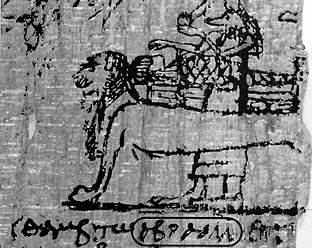
This is significant because it shows that, in at least some Egyptian contexts, Abraham was directly connected with this exact type of imagery. In other words, the association between Abraham and a lion-couch scene was not invented by Joseph Smith. It already existed in the ancient world. Yet this papyrus was completely unknown in the nineteenth century. Joseph Smith had no access to it, no knowledge of its contents, and no way to anticipate its discovery.
If scenes like Facsimile 1 were never associated with Abraham, it becomes difficult to explain why independent Egyptian material would later make that very connection. The Leiden Papyrus demonstrates that ancient Egyptians and Greek-speaking Egyptians preserved traditions linking Abraham to imagery that closely matches Facsimile 1.
Human Sacrifice by Egyptians
A major objection to the authenticity of the meaning of Facsimile 1 has been the claim that Egyptians did not practice human sacrifice.
Egyptological research now shows that human sacrifice did occur in Egypt, specifically in religious contexts involving rebellion, blasphemy, or offenses against the gods. And these events are documented in periods that overlap with the life of Abraham.
The Book of Abraham describes Abraham being targeted for execution because he rejected the worship of local gods. In light of what is now known, that scenario fits the ancient religious world far better than critics once assumed. Rather than contradicting Egyptian history, the account aligns with practices that were real in the ancient Near East.
Knife, Fire, and Ritual Practice
Some critics argue that ancient traditions describe Abraham being burned, while Facsimile 1 depicts a knife, and they treat this as a contradiction.
In ancient sacrificial practice, execution and burning involved killing the victim, often with a knife, and then burning the body as part of the ritual. Egyptian religious practice followed this same pattern, especially in cases involving offerings or punishments connected to the gods.
The knife in Facsimile 1 does not contradict traditions that speak of burning. It fits naturally within the broader ritual process. The Book of Abraham’s description aligns with how ancient sacrifices were actually carried out, rather than reflecting a misunderstanding of ancient practice.
In addition, the shape of the knife as depicted in Facsimile 1 is the same kind of blade that was used in antiquity.
If Joseph Smith was just making up a knife in the facsimile scene, how did he get that right?
Canaanite Gods Named in the Scene

Joseph Smith identified four specific gods in Facsimile 1 and named them. At the time, critics dismissed these names as invented because they did not appear in the Bible, in Greco-Roman mythology, or in any English reference works available in the early nineteenth century. From a modern standpoint, this would have looked like a bold and unnecessary risk if Joseph Smith were simply making things up.
Later discoveries changed the picture entirely. Subsequent research in ancient Near Eastern texts showed that all four names correspond to real deities worshipped in the Canaanite world. These names come from a cultural and geographic setting connected to Abraham’s background, not from later biblical or classical traditions. Importantly, this information was not available in Joseph Smith’s lifetime. The relevant texts were untranslated, unpublished, or not yet discovered.
This is not a vague parallel or a general similarity. It is a precise match involving specific divine names tied to a specific ancient religious setting. The likelihood of correctly identifying multiple obscure Canaanite deities by chance, without access to the sources that later confirmed them, is extremely small. When details like this repeatedly align with later discoveries, the explanation that Joseph Smith was merely guessing becomes increasingly difficult to sustain.
The Crocodile and Pharaoh
Facsimile 1 includes a crocodile figure beneath the lion couch, which Joseph Smith associated with Pharaoh. For many years, critics dismissed this interpretation as mistaken, arguing that the crocodile had no meaningful connection to Egyptian kingship in standard funerary scenes.
Later Egyptological research has shown that this criticism was based on incomplete understanding. During the Middle Kingdom, the period commonly associated with Abraham, Egyptian Pharaohs were linked with the god Sobek, who was represented as a crocodile. Sobek was not a minor deity. He functioned as a symbol of royal power, authority, and divine kingship, and Pharaohs were often identified with him as an embodiment of their rule.
This association was strongest in the time period relevant to Abraham. Joseph Smith’s interpretation aligns with this earlier context. Once again, the accuracy is not general or symbolic in a vague way. It is period-specific. That makes the explanation that Joseph Smith simply guessed difficult to maintain.
The “Pillars of Heaven”
Joseph Smith describes architectural elements in Facsimile 1 as the “pillars of heaven.” Critics have often argued that these features are simply a palace façade and that Joseph’s description reflects a misunderstanding of Egyptian architecture.
Further Egyptological study has shown that this criticism misses the symbolic function of these structures. Palace façades were commonly used in temple and ritual contexts and carried cosmic meaning. They marked the boundary between the earthly realm and the divine realm. In many temples, these architectural forms supported ceilings painted with stars, visually representing the heavens above.
Within that symbolic framework, referring to these structures as the “pillars of heaven” accurately reflects how Egyptians understood sacred space, cosmic order, and the connection between heaven and earth. Joseph Smith’s explanation aligns with temple symbolism rather than modern architectural labels, again pointing to a deeper and more accurate understanding of ancient religious meaning.
For more examples of things pertaining to Facimile 1 that Joseph Smith could not have known, read this article on by Fair Latter Day Saints.
Why the Criticism Misses the Point
Most criticism of Facsimile 1 assumes the image must be read only through a late Egyptian funerary lens. That assumption overlooks how ancient symbols were actually used and understood. That misunderstands the original context that Joseph Smith was trying to share and restore.
Well after the Book of Abraham was published, later discoveries show that Abraham was associated with lion-couch scenes in Egypt, that human sacrifice did occur under certain religious conditions, that the gods named by Joseph Smith were real ancient deities, and that the symbolism Joseph described fits the correct historical time period.
When the full ancient context is considered, the claim that Facsimile 1 has nothing to do with Abraham does not hold up.
Dismantling Faulk’s Erroneous Assumptions about Facsimile 1
Before addressing the details, it is important to be clear about what is actually being critiqued here. Referring to this as Faulk’s explanation of Facsimile 1 is somewhat misleading. The arguments he presents are not original, nor are they the product of independent Egyptological or historical analysis. They are largely inherited from the CES Letter and rely on the same assumptions, same interpretive framework, and same misunderstandings about what the Book of Abraham is and how ancient texts and images function.
Like the CES Letter, A Letter For My Wife treats Facsimile 1 as if it were meant to function as a modern academic translation exercise, judged solely by present-day Egyptological conventions. Neither document shows awareness of how ancient religious imagery was reused, recontextualized, layered with meaning, or transmitted across time. With that context in mind, Faulk’s argument collapses under closer scrutiny.
1. Calling Facsimile 1 a “Common Funerary Scene” Proves Nothing
Faulk correctly identifies Facsimile 1 as resembling what modern Egyptologists classify as a lion-couch scene. That point is not disputed. The failure comes in assuming that identifying the type of scene exhausts its meaning.
Lion-couch scenes appear across centuries of Egyptian history and in a wide range of ritual, theological, and symbolic contexts. Egyptologists themselves acknowledge that these scenes can represent embalming, resurrection, purification, divine judgment, protection from violent death, or preparation for execution. They are symbolic images, not literal snapshots of a single ritual. The supposed “similar” Lion Couch scenes from funerary texts all have the figure as a dead sarcophagus, not as a living man like we see in Facsimile 1.
More importantly, Faulk’s argument depends on the false premise that Egyptologists already understood these scenes clearly and definitively in Joseph Smith’s time. That is not the case. Egyptian hieroglyphs were only partially deciphered beginning in 1822, and early work focused on royal names and monumental inscriptions, not funerary papyri or ritual iconography. There was no settled scholarly understanding of lion-couch scenes in the 1830s. Even today, Egyptologists disagree on details.
Calling the image “Osiris embalming” is a modern scholarly label applied long after Joseph Smith. It does not prove how ancient viewers understood the image, nor does it rule out other interpretive layers that may have existed earlier.
2. Faulk Assumes Egyptian Meaning Was Fixed, Singular, and Fully Known
Faulk’s critique assumes Egyptian religious imagery had one correct meaning, shared universally, across all periods. That assumption is historically indefensible.
Egyptian symbols were intentionally multivalent. The same image could serve funerary, cosmological, priestly, and mythological purposes simultaneously. Egyptian priests regularly reused older imagery and applied new meanings without seeing contradiction. This is a basic feature of Egyptian religion.
Joseph Smith was not attempting to catalog Egyptian gods or provide a technical Egyptological translation. He was explaining what the scene represented within a theological narrative tied to Abraham. Faulk treats symbolic interpretation as error only by imposing a modern academic standard that Joseph never claimed to be using.
Faulk also claims that Joseph Smith penciled in missing portions of the image. This claim is misleading. We do not know who restored the damaged sections of the papyrus, when they were restored, or on what basis. The restorations were made in the nineteenth century, likely by artists working from assumptions common at the time, not trained Egyptologists. Some restorations are demonstrably incorrect, including inverted or misoriented characters.
Faulk treats those restorations as authoritative and then faults Joseph Smith for not matching them. That reverses the burden of proof. Joseph was offering an interpretation of the original scene, not of a later reconstruction layered onto a damaged copy of a copy of a copy, adapted for funerary use by Hor centuries after Abraham.
Faulk also insists that the standing figure must have had an Anubis head originally. That is possible. It is not certain. Egyptologists themselves disagree about reconstructions, and there is no surviving original to resolve the question. But even if the figure were Anubis, that does not undermine Joseph Smith’s explanation. In Egyptian art, priests could be depicted as gods, gods as priests, and symbolic figures could represent historical or theological roles. Iconography does not limit meaning.
Joseph was not identifying costumes. He was explaining what the scene represented.
3. Misidentification Claims Confuse Labels with Function
Faulk repeatedly claims Joseph “misidentified” figures because they do not align with modern labels like “Anubis” or “sons of Horus.” This assumes that naming an iconographic type exhausts symbolic meaning. Ancient religion does not work that way.
Symbolic substitution was standard practice. A figure depicted with Anubis-like features does not restrict the scene to one narrative. Joseph Smith’s explanations address function and meaning, not taxonomic classification.
4. Damage and Reconstruction Are Far More Uncertain Than Faulk Admits
Faulk minimizes the damaged state of the papyrus and exaggerates scholarly certainty. The papyrus was already fragmentary when Joseph acquired it. Missing portions were reconstructed later, and those reconstructions are speculative. Egyptologists disagree about what originally appeared in those sections.
Reconstructions are educated guesses, not recovered originals. Treating them as definitive proof against Joseph Smith is unjustified.
5. Faulk’s Argument Implicitly Excludes Ritual Killing Without Justification
Faulk does not explicitly claim that Egypt never practiced ritual killing or human sacrifice. However, his argument depends on treating lion-couch scenes as strictly non-sacrificial embalming imagery, which implicitly excludes the possibility of execution or attempted sacrifice.
That exclusion is unwarranted. Later Egyptological research has documented ritual killing and execution in Egypt under certain religious and legal conditions. This means a knife-wielding figure over a bound individual cannot be dismissed out of hand.
Faulk’s argument relies on narrowing the scene’s function in a way ancient religion does not support.
6. Knife vs. Fire Is a False Objection
Faulk suggests that because some Abraham traditions describe burning, a knife scene cannot represent the same event. This assumes a false choice. In ancient ritual practice, execution often involved killing the victim first and then burning the body. A knife does not contradict a burning tradition. It supports it.
7. Abrahamic Reuse of Egyptian Imagery Is Documented
Faulk ignores evidence that Abrahamic traditions reused Egyptian imagery. A lion-couch scene discovered in Thebes centuries later includes Greek text explicitly naming Abraham beneath the image. This demonstrates that ancient people in Egypt did associate Abraham with this type of imagery. Joseph Smith could not have known about this material.
8. Facsimile 1 Is Not a “Pass or Fail” Test
Faulk treats Facsimile 1 as a decisive failure point. That approach only works if one assumes:
- Egyptian symbols had one meaning
- That meaning never changed
- Modern scholars fully understand it
- Joseph Smith claimed to provide a modern Egyptological translation
None of those assumptions are true.
Final Assessment
Faulk’s Facsimile 1 argument inherits the same flaws found in the CES Letter. It mistakes classification for meaning, reconstruction for certainty, and modern academic categories for ancient religious interpretation.
When the broader historical and ancient context is applied, Facsimile 1 cannot be dismissed as irrelevant to Abraham. The evidence supports layered meaning, symbolic interpretation, ritual violence consistent with the text, and documented Abrahamic association.
Facsimile 1 does not disprove the Book of Abraham. It exposes the weakness of arguments that assume ancient religion was simple, fixed, and already fully understood. It also demonstrates that Joseph Smith understood so many things about ancient Egyptian culture that are now verified by modern Egyptian scholarship.
The Rosetta Stone – The Ancient Relic Not Related to The Book of Abraham

Book of Abraham Facsimile 1
Understanding What The Book of Abraham Facimilies Are
Book of Abraham – Evidence Joseph Smith Could Not Have Known
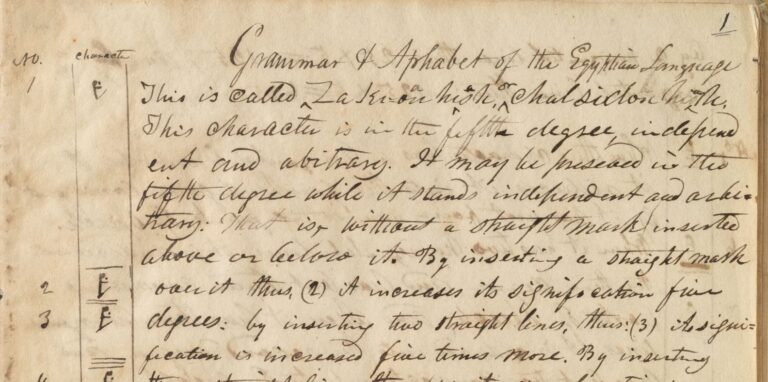
The GAEL Project – Pre-Temple Doctrine Coding?
Doctrine of the Book of Abraham
What is the Book of Abraham?
Continue reading at the original source →