


The Kinderhook plates are a small un-noteworthy blip in the story of Joseph Smith’s very complex and full life. Because they have nothing to do with revelation, there is no doctrine that comes from them and no real benefit to studying them. There is simply no reason for them to ever come up in normal church history discussions or seminary settings.
The only time the Kinderhook plates are brought up today is when anti-Mormons try to use them to discredit the prophet Joseph Smith. But as I have studied the history and put the pieces of this story together, it turns out that the reason we even know the truth about the Kinderhook plates is because of a failed anti-Mormon effort in 1879. Ironically, it was those anti-Mormon attempts that preserved the evidence showing that Joseph Smith did not fall for a hoax.
Yet anti-Mormons still attempt to use the same discredited argument from the 1800s.
What are the Kinderhook Plates?
On April 23, 1843, in Kinderhook, Illinois, a group of men, including two Latter-day Saints, dug into an ancient Native American burial mound and uncovered human bones along with six brass plates. The plates were described as bell-shaped.
As you can imagine, the Latter-day Saints were very excited to see metal plates, since this would support the idea of ancient records similar to the Book of Mormon. At the time, scholars and archaeologists mocked the idea that ancient records could exist on metal plates. If the Kinderhook plates had been real, they would have been seen as strong evidence that ancient people like those in the Book of Mormon did indeed use metal plates.
Locals around Kinderhook were excited about the discovery, and over the next few days the plates were displayed in Pittsfield, Illinois, and other nearby settlements along the Mississippi River.
The Latter-day Saints who were present at the dig asked for permission to take the plates to Joseph Smith in Nauvoo for examination, and the owners agreed to loan them out.
Kinderhook Plates in Nauvoo
On April 29th the plates arrived in Nauvoo, and were there for five days. There was no official or public display, like was done for the Abraham Papyrus, but the plates were shown privately to Joseph Smith as well as a few individuals. There was lots of excitement and speculation about what they might be and if Joseph Smith could translate them.
In the Nauvoo Times and Seasons a brief editorial note was made that said, only this about the Kinderhook Plates:
Mr. Smith has had those plates, what his opinion concerning them is, we have not yet ascertained.
Translation of the Kinderhook Plates
The only reason the Kinderhook plates are discussed today is because critics claim they prove Joseph Smith was a false prophet. The argument is that Joseph translated plates that were not authentic and were later exposed as a hoax.
In response, some Mormon apologists have argued that Joseph briefly attempted a scholarly or linguistic analysis but never sought revelation. However, this defense doesn’t acknowledge the content on the Grammar and Alphabet of the Egyptian Language or assumes it has something to do with an actual Egyptian translation guide.
When the GAEL project is understood for what it actually was, and when the testimony of the man who helped create the hoax is examined, the evidence points to a much simpler conclusion. Joseph Smith never attempted to translate the Kinderhook plates at all.
Joseph Smith’s Egyptian Characters Notebook
To understand what people later assumed was a “translation” of the Kinderhook plates, it is first necessary to understand Joseph Smith’s Egyptian notebook.
The Grammar and Alphabet of the Egyptian Language was a project begun in 1835, eight years before the Kinderhook plates appeared. It involved W. W. Phelps, Oliver Cowdery, Warren Parrish, Willard Richards, and Joseph Smith. The notebook contains copied symbols, assigned categories, and expanding descriptions that increase in complexity by degrees.
Rather than functioning as a linguistic dictionary, the GAEL reads more like a symbolic or coded framework. It appears to be an attempt to organize ideas and meanings in a way that could communicate doctrine at a time when temple ordinances and their symbolic structure had not yet been introduced.
The GAEL was created after Joseph had already translated the Book of Abraham by revelation. Some characters from the Egyptian papyri were copied into the notebook, but most of the characters are not Egyptian at all and do not function as a real language. The project was never presented as scripture and was eventually abandoned.
Joseph Compares Characters
Joseph Smith did examine the Kinderhook plates and compared their characters with materials he already possessed, including his Hebrew Bible and his Egyptian Alphabet and Grammar notebook.
This comparison was brief and informal. There is no record of Joseph praying for revelation, dictating a translation, or involving scribes. Nothing was written down, published, or expanded upon. Whatever took place ended quickly and was not treated as significant by Joseph himself.
Witnesses of the “Translation”
There are only two sources that are ever cited as evidence that a translation of the Kinderhook plates occurred. Neither describes a translation process, and neither records Joseph claiming revelation.
Witness from a Non Member
One source is an unnamed non-member who observed Joseph Smith examine the Kinderhook plates. He later wrote to the New York Herald, describing how the plates were brought in and shown to Joseph, and how Joseph compared the strange symbols with characters from his Grammar and Alphabet of the Egyptian Language.
The writer assumed this meant Joseph would be able to decipher the plates, but that conclusion was his own. He also incorrectly assumed that Joseph’s Egyptian notes came from the Book of Mormon, something no one believes today. This mistake shows that the account is filled with the observer’s assumptions rather than a careful explanation of Joseph’s process or an actual translation.
Even so, the account is valuable because it confirms that Joseph approached the plates in a normal, secular way by examining and comparing characters. It does not describe revelation, dictation, or translation. It describes curiosity and comparison.
Comparing Characters
When Joseph examined the Kinderhook plates, he compared their characters to material from an earlier project. One symbol on the plates, a curved, boat-like shape, closely resembled a character found in the Grammar and Alphabet of the Egyptian Language (GAEL).
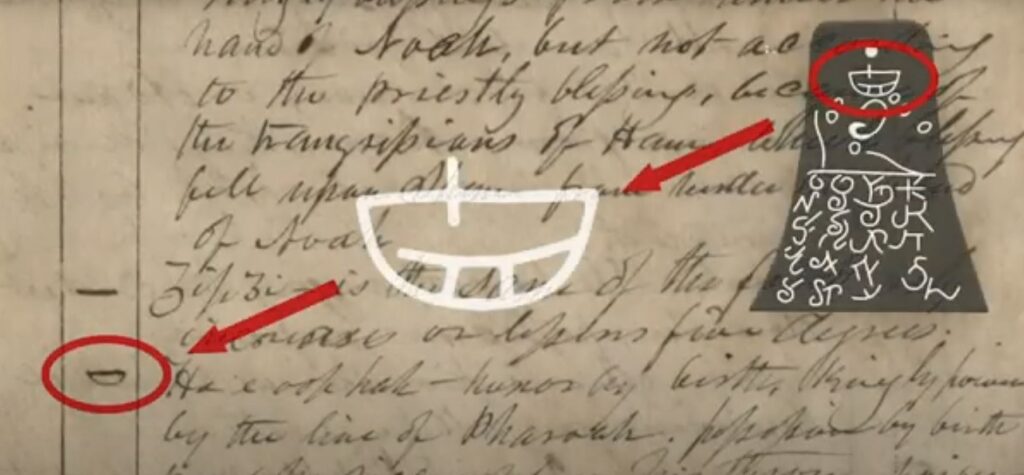
On the GAEL page where that boat-like character appears, the accompanying text describes a royal lineage descended from Ham through Pharaoh. It speaks of a figure entrusted with ancient records and traditions, portrayed as a prince of royal blood who inherits kingship but not priesthood authority because of the transgression of Ham. The language emphasizes kingly power granted by heaven, dominion by birth, and possession of “heaven and earth.”
William Clayton’s Translation Assumption
William Clayton is the only other source that mentions anything resembling a translation. Critics rely heavily on his journal entry as proof that Joseph Smith translated the Kinderhook plates. Clayton wrote the following in his personal journal:
President J. has translated a portion and says they contain the history of the person with whom they were found, and he was a descendant of Ham through the loins of Pharaoh king of Egypt, and that he received his kingdom from the ruler of heaven and earth.
After reading the text on the page of the GAEL with the boat character, it appears that William Clayton thought that the 1835 Gael notebook was Joseph’s translation of the Kinderhook plates.
William Clayton was not involved in the GAEL project of 1835. He did not immigrate to the United States until 1840, five years after the project began, and he had no role in its creation. There is no indication he understood what the notebook was, how it was created, or that it had already been abandoned. To Clayton, the notebook may have appeared to be a translation document rather than a speculative study project.
What is clear is that there is a strong textual connection between Clayton’s journal entry and the GAEL page. This strongly suggests that Clayton assumed the GAEL material represented Joseph’s translation of the Kinderhook plates.
It is also possible, though speculative, that Joseph simply remarked that a Kinderhook symbol resembled one in the notebook. Clayton may then have read the description beside it and assumed that was the meaning Joseph intended. Joseph may have said something as simple as, “This is the symbol we associate with Ham or a ruler.”
Because bones were found at the burial site, Clayton may have further assumed that Joseph was referring to the individual whose remains were uncovered and concluded that the buried person was the descendant of Ham described in the notebook.
Regardless of how Clayton reached his conclusion, there is no evidence that Joseph Smith ever translated, or claimed to translate, the Kinderhook plates.
Why Not Book of Mormon Evidence?
If Joseph Smith were fabricating a translation to bolster the Book of Mormon, the content Clayton recorded makes no sense. Why would Joseph describe a descendant of Ham and Pharaoh, figures tied to the Old World, when the Book of Mormon concerns peoples on this continent?
If Joseph were inventing a story, it would have been far more logical to claim the plates were Jaredite or Mulekite records. That he did not do this is telling.
The reason is simple. It never happened. Joseph Smith never attempted a translation of the Kinderhook plates. Clayton’s explanation of translation had something to do with the content in the Gael notebook.
Errors in Later First Person Biographies
After Joseph Smith’s death, Willard Richards began compiling records about Joseph from multiple sources, including Joseph’s own journal and those of Wilford Woodruff and William Clayton. This material was edited into a first-person narrative, a common biographical practice at the time.
The History of the Church was published in 1909 under the direction of B. H. Roberts. It is here, for the first time, that Clayton’s journal entry is rewritten in the first person as Joseph saying, “I have translated a portion.”
That wording does not come from Joseph Smith. It is an editorial reconstruction based on Clayton’s summary.
Joseph Never Said, “I Translated the Plates”
Joseph Smith never claimed he was translating the Kinderhook plates. He never dictated a translation, never employed scribes, and never presented any text. This stands in sharp contrast to every known instance where Joseph translated scripture, including the Book of Mormon, the Book of Moses, the Book of Abraham, and the revelations in the Doctrine and Covenants.
In those cases, scribes were always present and records were always produced.
Likewise, unlike the Egyptian papyri associated with the Book of Abraham, which the Church made sacrifices to obtain, there was no effort to purchase or retain the Kinderhook plates. They appear to have held little interest once Joseph examined them.
Joseph Refused to Attempt a Translation
We also have a verified first-hand testimony that Joseph Smith “would not attempt a translation.”
According to Wilur Fugate, one of the men responsible for creating the hoax:
Joseph Smith said he would not attempt a translation unless the plates were sent to “the Antiquarian Society of Philadelphia, or to France or England,” and unless those societies certified them as genuine antiquities.
This statement strongly implies that Joseph did not believe the plates were authentic. Rather than affirming them, he required outside verification as a condition to proceed.
Fugate claimed that Robert Wiley took responsibility for sending the plates to antiquarian societies. According to Fugate, the societies replied that the characters were unknown and could not be classified.
Kinderhook Plates Fade into Oblivion
On May 24, the Nauvoo Neighbor published a hand-drawn illustration of the six Kinderhook plates along with this paragraph describing their discovery:
“Mr. Smith has had those plates, and compared the characters with those on the Book of Mormon plates, and they are evidently the same.”
The paper did not say Joseph translated them or declared them ancient. It reported only that he examined and compared characters. The word “evidently” reflects the newspaper’s speculation, not Joseph’s claim.
This line is important because it says nothing about revelation or a real translation. It reflects comparison and curiosity, not certainty.
Assumptions and Misunderstanding Among The Saints
The Nauvoo Neighbor repeated the general excitement that the Kinderhook plates could be an ancient record. In a time when archaeology was poorly understood and critics mocked the idea of ancient metal records in America, this possibility naturally generated interest and speculation among Latter-day Saints and the surrounding community. Although no revelation or translation was reported, the suggestion alone fueled assumptions.
As news spread, excitement was passed along without clear distinctions between examination, comparison, and translation. Over time, secondhand accounts blurred these differences, leading some Saints to assume that Joseph Smith must have translated the plates in some way, even though no translation was produced or published. These assumptions persisted for years, not because of any official claim, but because early enthusiasm and incomplete reporting created a narrative that was never formally corrected. Later critics treated these misunderstandings as evidence, inflating a minor historical episode into a challenge to Joseph Smith’s prophetic role, despite the lack of supporting evidence.
1879 Wilbur Fugate Reveals The Hoax
In 1879, thirty-six years after the plates were discovered, Wilbur Fugate wanted to set the record straight and admitted that the Kinderhook plates were a hoax.
He stated that he, Wiley, and Whitten planned the hoax because they wanted to fool Joseph Smith and embarrass the Mormons. Whitten cut the plates from copper, and he and Wiley etched the characters using beeswax molds and acid, then buried them in a mound that already contained bones and ancient remains.
They then staged a public dig to “discover” the plates. The Latter-day Saints who were present were part of the staged audience and were not involved in the deception. Fugate noted that Joseph Smith refused to translate the plates without external authentication, and that the plates were sent to antiquarian societies, which were unable to verify the characters as ancient. After that, the hoax was exposed as a humbug.
The Record that Needed to be Set Straight
TLDR Kinderhook Plates Conclusion
The Kinderhook plates were a hoax intended to trick the Saints and make Joseph Smith look foolish, but the attempt failed. Ironically, the reason we know this is because anti-Mormon critics tried to use the plates as evidence against Joseph Smith. In doing so, they preserved the only primary source from one of the men who created the hoax, who admitted that Joseph Smith refused to translate the plates and never treated them as an authentic ancient record.
This incident is a complete humbug, not because the plates were fake, but because of how critics have misrepresented what actually happened. A minor, inconsequential event has been exaggerated into a supposed test of Joseph Smith’s prophetic calling by ignoring the primary sources and the historical context. When the full record is examined, the narrative collapses. Joseph Smith did not translate the plates, did not claim revelation, and did not treat them as authentic scripture. The only reason the Kinderhook plates are still discussed today is because critics continue to rely on misinformation and assumptions to manufacture a controversy that the historical evidence does not support.
What Letter For My Wife Gets Wrong
The “Letter for My Wife” get’s so many things wrong about the Kinderhook plates.
1. Joseph Smith Did Not Claim a Divine Translation
Letter for My Wife states that Joseph Smith pronounced the plates genuine and translated their ancient characters. There is no contemporary evidence for this claim. Joseph never dictated a translation, never hired scribes, and never presented the plates as scripture. The only source used to support this assertion is a later editorial wording in the History of the Church, not a statement from Joseph himself.
2. The “Translation” Quote Comes From Clayton’s Assumption, Not Joseph
The line “I have translated a portion” does not come from Joseph Smith. It originates in William Clayton’s private journal and was later rewritten into the first person during the compilation of the History of the Church. Clayton did not quote Joseph, nor did he describe Joseph dictating or claiming a revelation.
More importantly, Clayton wrote this entry after Joseph had compared the Kinderhook characters with existing Egyptian study materials. Clayton appears to have assumed that Joseph’s earlier Egyptian papers already represented a translation framework and therefore treated Joseph’s brief comparison as a completed “translation.” That assumption was later frozen into print through editorial rewriting, even though no actual translation event occurred.
3. Clayton Likely Mistook the Egyptian Papers for the Kinderhook Translation
Clayton did not record any translation process. He did not mention prayer, revelation, scribes, or dictation. Instead, the content he summarized closely matches language already present in the 1835 Egyptian Papers, specifically the GAEL.
Given that those Egyptian papers were physically present during Joseph’s examination of the Kinderhook plates, it is likely Clayton believed they represented Joseph’s translation work on the plates. Rather than recording new revealed text, Clayton appears to have interpreted existing GAEL explanations, particularly those referencing Ham, Pharaoh, and royal lineage, as the meaning of the Kinderhook symbols. This misunderstanding explains why Clayton recorded a “portion” that aligns with the GAEL while no translation manuscript, continuation, or publication ever followed.
4. Independent Eyewitnesses Confirm a Secular Examination
A non-member eyewitness wrote to the New York Herald describing Joseph comparing the Kinderhook characters with his Egyptian Alphabet notebook. The observer made his own assumptions about what this meant, but his account confirms Joseph approached the plates analytically, not prophetically.
5. Joseph Refused to Translate Without Authentication
Wilbur Fugate, one of the men who created the hoax, stated that Joseph Smith refused to translate the plates unless they were authenticated by antiquarian societies. This directly contradicts the claim that Joseph accepted the plates as genuine or attempted a divine translation.
6. Later LDS Speculation Does Not Equal an 1843 Translation
Letter for My Wife incorrectly treats later twentieth-century speculation about the plates as proof of Joseph’s actions in 1843. Early confusion about the plates’ authenticity does not create a translation event that never occurred. When better scientific testing was done, those later assumptions were corrected.
7. Claims of Church Deception
Letter For My Wife presents the changing assessments of the Kinderhook plates as evidence that the Church was lying or intentionally deceiving members. This framing is inaccurate and ignores how historical and scientific evaluation actually works.
The early examinations of the Kinderhook plates were limited by the technology available at the time. The 1953 assessment relied on visual inspection by professional engravers, not chemical or microscopic analysis. Their conclusion reflected the tools and methods they had, not a coordinated effort to mislead. When more advanced technology became available decades later, the Church allowed and published new testing that overturned the earlier assumption.
Rather than concealing the results, the Church openly acknowledged the hoax in the 1981 Ensign and presented the scientific evidence in detail. This is the opposite of deception. It shows a willingness to revise conclusions when better evidence becomes available.
Most importantly, none of these later tests change the historical fact that Joseph Smith never translated the Kinderhook plates by revelation or presented them as scripture. The shift in scientific conclusions concerns the physical plates, not Joseph’s prophetic claims. Framing this process as dishonesty misrepresents both the history and the evidence.
8. The Argument Depends on Stacked Assumptions
The critical claim relies on several assumptions:
- That Joseph believed the plates were ancient
- That Clayton recorded details from a revelation, rather than an 1835 document
- That editorial rewrites reflect Joseph’s own words
- That silence equals confirmation
More Resources
For more info on what LFMW gets wrong about the Kinderhook plates, be sure to check out Sarah Allen’s article.
Continue reading at the original source →