


 November 21st, 1984. I’d been on my mission for fourteen months. I was working in Puno, high up on the Altiplano at 12,500 feet on the shores of Lake Titicaca. Besides Elder Moore—a culture shocked, baby-faced elder straight from the States whose sunburned nose was blistering in the altitude and whose stomach was in constant upheaval at its strange new diet—I was one of few North American missionaries in the area. I was training a greenie from Lima, Hermana Francia, who kept hijacking the discussion when it was my turn to teach and who balked at the chuno in our soup. We spent our days traipsing up and down steep dirt hills and stepping over sewage running down the muddy streets; and teaching impoverished families in one-room adobe huts with dirt floors, guinea pigs squealing under the beds and chickens wandering in and out. At night we wore thermals under our pajamas, as well as gloves, socks, and hats, and we curled under piles of blankets and listened to the thunderstorms raging over the hills. In the mornings the water in our tap was so cold that it left ice crystals in our hair when we washed it.
I’d just found out after weeks of bloating and pain that my amoebas were back. I also had a cold and hadn’t slept well in days. That morning our investigator, Marisa, had been too drunk after a late-night party to listen to our charla; and our golden family’s baptism, scheduled for the following Sunday, had fallen through during their baptismal interview that afternoon when Hermano Roque confessed that he and Hermana Roque weren’t actually married. As dusk settled over the city, Hermana Francia and I trudged home through a torrential rainstorm, lightning flashing all over the sky, arriving home with soaked shoes and icy fingers. At supper, I quarreled with our pension lady over the bread—she refused to give us the two rolls promised in our pension agreement–and I ended up blubbering into my warm milk.
And then I remembered: the next day was Thanksgiving.
The next morning, with our district leader’s permission, Hermana Francia and I walked to the outdoor market, where sheep heads and pigs’ feet and slabs of cow stomach hung on hooks, stray dogs sniffing in the dirt below. 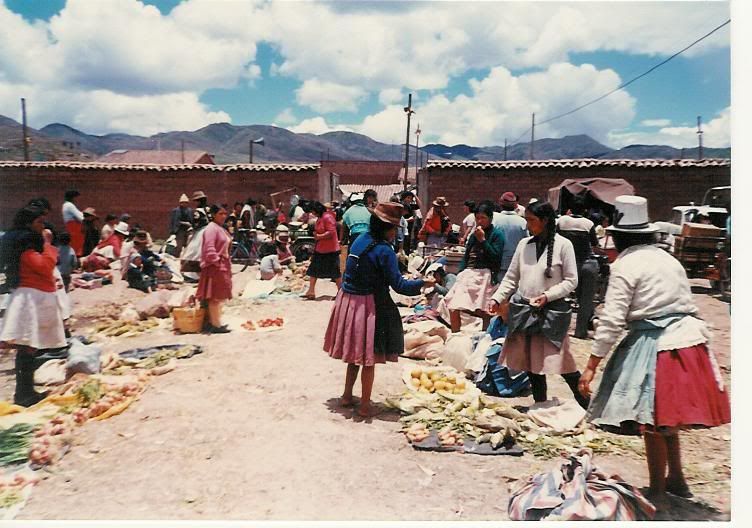 Women dressed in their traditional colorful skirts and bowler hats, with babies slung on their backs, sold us potatoes, cobs of corn, apples, yams, and two scrawny chickens, and we carried everything home in our netted shopping bags. After we borrowed dishes and utensils from our landlady’s kitchen, Hermana Francia showed me how to pluck the chickens and clean out their gizzards. We sent the elders—who were excited at the prospect of an American feast (especially poor Elder Moore)—to buy butter and cream and to scout out an oven, and they came back reporting that a bakery down the street had agreed to let us use theirs. All morning we worked in our makeshift kitchen, peeling potatoes, stuffing the chickens, candying the yams. Feeling brave and reckless, I made an apple pie without a recipe, guessing as I kneaded butter and sugar into flour and scattered sugar and cinnamon over thinly sliced apples. While we boiled the potatoes over a Bunsen burner on our little table, the elders ferried the chickens and the yams and the pie to the bakery and back—and the bakery oven was so hot that the pie cooked in just twenty minutes.
At 1:00 our district—four elders and two sisters—as well as the welfare sisters, sat down to a miraculous feast, spun out of thin air, it seemed, assembled with ingenuity and hope in a missionary sisters’ rented room. I thought Elder Moore was going to start weeping as he lifted a forkful of mashed potatoes to his mouth. He ate and ate and ate, murmuring, “Que delicioso” over and over. Elder Jara told silly jokes as we feasted, and we laughed and chattered and ate until our stomachs ached. I have to admit, that apple pie was—and continues to be—the best apple pie I’ve ever tasted.
That night, Hermana Francia and I visited the Roque family and we talked about getting started on the papers they would need to get married. In their little adobe house nestled in the hillside, we taught Hermano Roque’s mother, a little, leather-faced woman who only spoke Quechua, the first discussion by candlelight as Hermana Roque translated for us. The little abuela clasped our hands and told us, through her daughter-in-law, that she knew we were messengers from God. Afterward we had a lively family home evening with the Roque family, played games with the children and listened as Hermano Roque recounted Inca legends while the wind whipped around the house.
We walked home through the muddy streets, the city lights below misted with rain, the hills behind us black and wet. A llama’s bell tinkled somewhere on the hillside. I pulled my sweater tightly around me and smiled in the darkness.
It was the best Thanksgiving I had ever had.
What are some of your fondest Thanksgiving memories? Have you ever had a transcendent dining experience, a meal that you will never forget?
Related posts:
Continue reading at the original source →